
Ascent Roofing & Restoration logo

RESTORATION

WATER DAMAGE RESTORATION

Water does not stay where it lands. It runs down framing, wicks up drywall, gets under flooring, and sits in cavities where nothing evaporates on its own.

We extract, dry to a measured standard, handle the contents, and rebuild what has to be replaced — 24 hours a day across Grayson, Collin, and Denton counties.

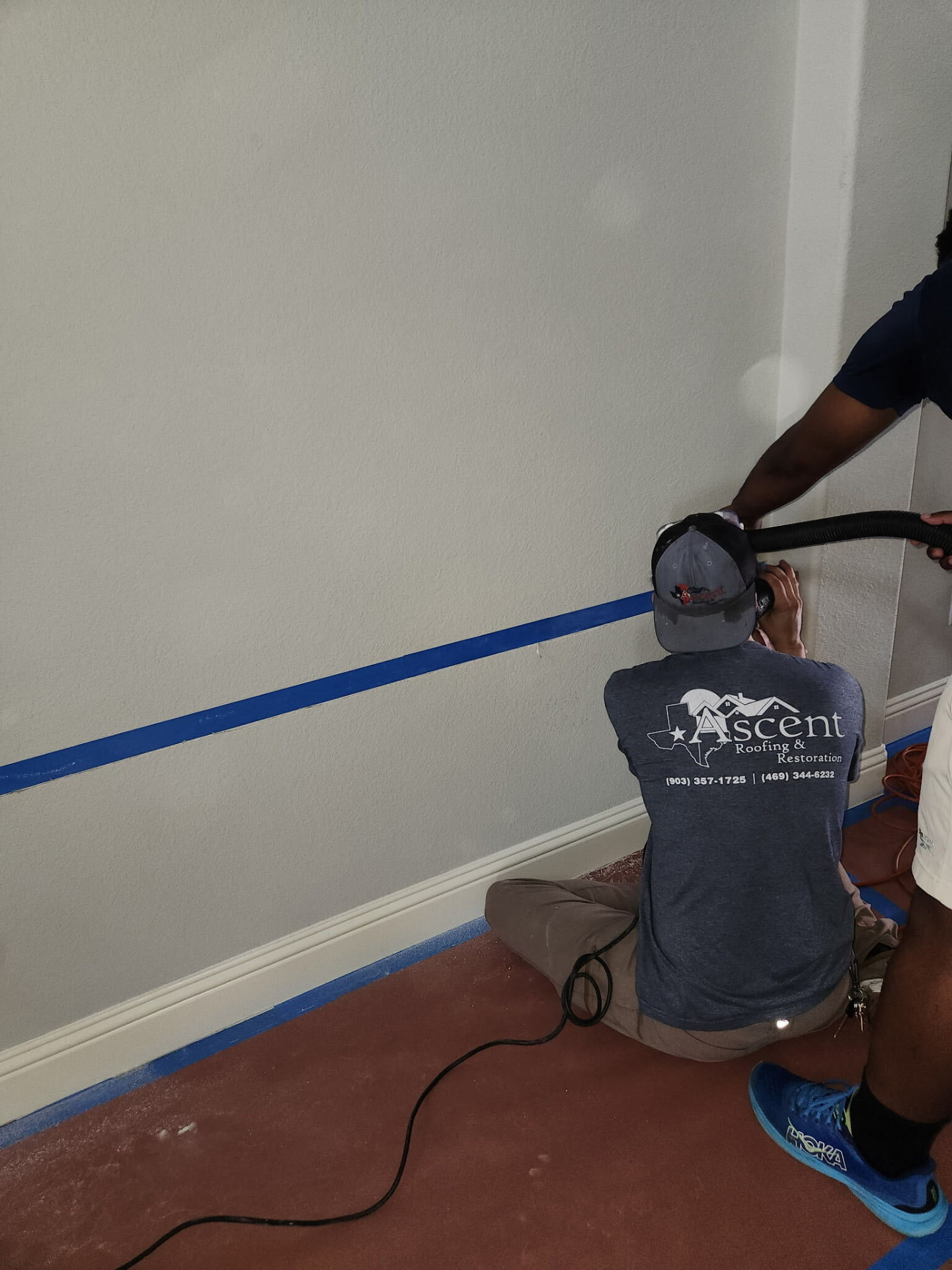
Ascent crew working along a wall during an interior restoration
Wall restoration

THE PROCESS

HOW A WATER LOSS RUNS

  • Emergency extraction of standing water
  • Moisture mapping with meters and thermal imaging
  • Contents inventoried, packed, and moved to storage
  • Controlled demolition of unsalvageable materials
  • Monitored structural drying with daily readings
  • Sanitization and odor control
  • Rebuild — framing, drywall, flooring, trim, paint
  • Contents cleaned and packed back

COMMON SOURCES WE SEE IN NORTH TEXAS

Storm-driven roof intrusion after a hail line is the biggest one, and it is the reason our roofing and restoration crews are the same company. Behind that: supply-line and water-heater failures, HVAC condensate pans overflowing through ceilings in August, slab leaks, and the January freeze events that split pipes in unconditioned attics and garages.

Commercial buildings add sprinkler discharges and roof drain failures on low-slope membranes, which put a great deal of water into a building in a very short time.

DRYING IS MEASURED, NOT GUESSED

Two fans in a hallway is not drying. We calculate the equipment load for the affected volume, set air movers and dehumidifiers accordingly, and take daily moisture readings on the same logged points until materials reach dry standard.

That log is also the proof your carrier needs that the building was actually dried before it was closed up.

MOLD, HONESTLY

Rapid drying is the mold answer. Microbial growth becomes likely inside 24 to 48 hours of sustained moisture, so speed matters more than any product sprayed afterward. Texas licenses mold remediation above a defined project size, and small isolated areas are exempt. Where a job crosses that line, an independent licensed assessor writes the protocol and licensed remediators execute it — we will tell you plainly which side of that line your job is on.

HOW WE DOCUMENT IT FOR YOUR CARRIER

We are contractors, not public adjusters. Texas law is clear that a contractor working on your property cannot adjust your claim, and we don't pretend otherwise. What we do is build the record your carrier needs: dated photographs of every affected area, written scope of work, moisture readings logged over time, and a room-by-room inventory when contents are involved.

We meet your adjuster on site so the scope conversation happens with everyone looking at the same roof and the same readings. Where your policy allows, we bill your carrier directly so you are not floating the job on a credit card.

ONE CALL HANDLES THE WHOLE LOSS

A loss rarely stays in one category. These are the pieces most often attached to this one — same company, same file, same schedule.

COMMON QUESTIONS

Is water damage covered by insurance?
Sudden and accidental water damage is typically covered; long-term seepage and maintenance failures typically are not. Your policy decides, not us. What we control is documentation good enough that the decision is made on facts.
How quickly do you respond?
24/7, with crews dispatched from Plano and Sherman. Active water intrusion is prioritized ahead of scheduled work.
Do I have to move out?
Often no. Many losses are contained to part of a building and drying equipment runs around you. Fire, sewage, and large-footprint losses usually mean relocation, and we tell you early so you can plan.

FREE INSPECTION. WRITTEN REPORT EITHER WAY.

We walk the property, photograph what we find, and hand you a written report whether you hire us or not.

One property per customer, minor repairs only, materials on hand, at inspector's discretion, subject to safe roof access. Offer terms subject to confirmation.